Polymorphism refers to the ability of something to take multiple forms. In Rails, a polymorphic association allows one model to belong to different types of models through a single association.
I've read about polymorphic associations many times and understood what they are in theory. But when deciding whether to use them or not, I lacked clear criteria for making that choice.
In this article, we are going to explore the reasoning behind polymorphic associations and the trade-offs they introduce.
The Problem
Let's think of a scenario where we are building a learning platform where:
- A quiz can have comments.
- A lesson can have comments.
- A post can have comments.
What are the ways we can implement these relationships?
1. We will create separate comment tables for each model.
Quiz -> QuizComments(id, text)
Lesson -> LessonComments(id, text)
Post -> PostComments(id, text)
All three tables store identical data. The only difference here is the parent model. It's a schema duplication and unnecessary separation of identical behaviour.
Let's consider alternative ways to implement these associations.
2. Create a single table which belongs
to all three parents. To implement this relationship, we will create
a comment table where quiz_id, lesson_id, and post_id
will be foreign keys.
| id | text | quiz_id | lesson_id | post_id |
|---|---|---|---|---|
| 1 | "comment on quiz" | 1 | NULL | NULL |
| 2 | "comment on lesson" | NULL | 1 | NULL |
| 3 | "comment on post" | NULL | NULL | 1 |
While this approach avoids duplication,
it introduces other issues. As the number of parent models grows,
the table gains more foreign key columns, which will be NULL
for any given row.
This makes the schema rigid, and adding a new parent type will require schema change, and enforcing the foreign key constraint becomes complex.
So how can we model this relationship without duplicating tables or making the schema messy?. This is where a polymorphic association becomes useful.
Polymorphic Association
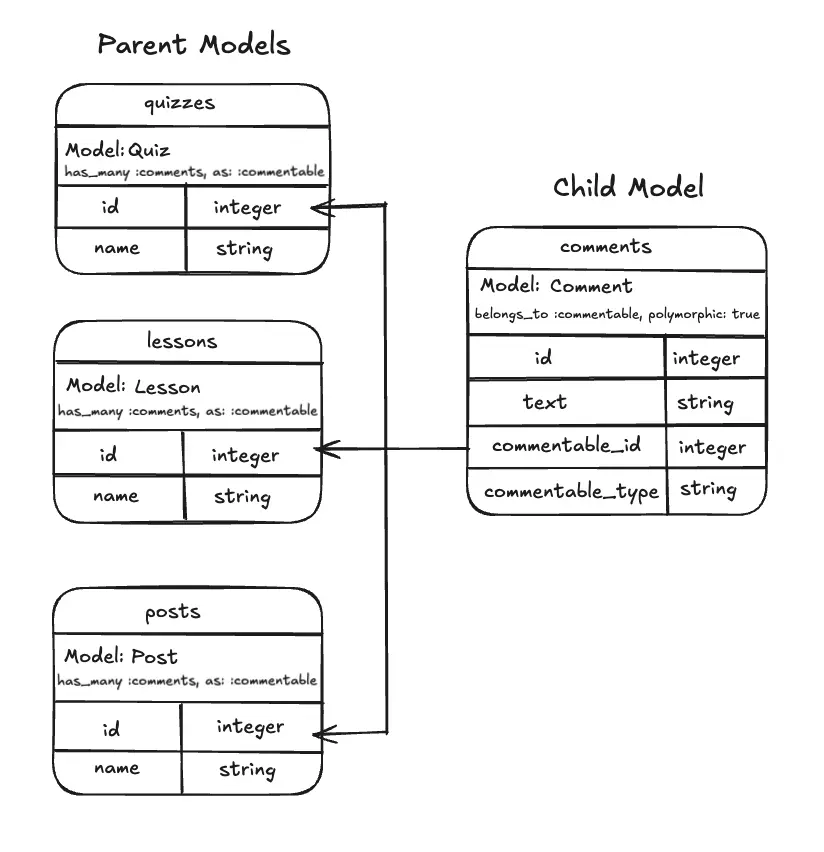
The core idea behind a polymorphic association is simple: instead of storing multiple foreign keys,
We store two columns - commentable_type and commentable_id.
Together, these columns identify both:
- The type of parent model.
- And the specific record it belongs to.
This denotes that the comment belongs to something polymorphic (commentable: something that can take multiple forms). It means a comment belongs to something that can be a Quiz, Lesson, or Post.
| id | text | commentable_type | commentable_id |
|---|---|---|---|
| 1 | "comment on quiz" | Quiz | 1 |
| 2 | "comment on lesson" | Lesson | 1 |
| 3 | "comment on post" | Post | 1 |
Each row stores the parent model's class name and the corresponding record id. This allows a single comment table to associate with multiple models.
For example first row says that the comment with id 1 belongs to the quiz with id 1. The second row says the comment id 2 belongs to the lesson with id 1, and so on.
A polymorphic association is useful when the child model behaves the same regardless
of parent model type, but needs to belong to a different type of models.
Modeling the Relationship
#Comment model

class Comment < ApplicationRecord
  belongs_to :commentable, polymorphic: true
end

# Quiz model

class Quiz < ApplicationRecord
  has_many :comments, as: :commentable
end


# Lesson model

class Lesson < ApplicationRecord
  has_many :comments, as: :commentable
end

# Post model

class Post < ApplicationRecord
  has_many :comments, as: :commentable
end
The as: :commentable option must match the association name defined in belongs_to.
Migrations
create_table :comments do |t|
  t.text :text
  t.references :commentable, polymorphic: true, null: false
  t.timestamps
end
Here, Rails generates commentable_type and commentable_id columns in the comments table.
Rails uses both values together to determine which model and which specific record the comment belongs to.
Notice that this design does not use a traditional database-level foreign key. Rails resolves the association at the application layer.
The Cost
No Database Level Foreign-Key Constraint
When we have a normal foreign-key relationship
add_reference :comments, :post, foreign_key: true, on_delete: :cascadeThis allows the database to enforce foreign key constraint, and this prevents invalid references and handle cascading deletes safely. Cascading deletes is a database feature that automatically deletes related records in child tables when a record in a parent table is deleted.
In a polymorphic association, this is not possible. Since commentable_id can refer to different tables depending on commentable_type, the database cannot enforce a traditional foreign key constraint.
Therefore, database-level cascading deletes won't work for polymorphic associations.
As a result:
- Referential integrity is not enforced at the database level.
- Orphaned records can exist if parents are deleted outside Rails.
Referential integrity ensures that a record cannot reference a parent that does not exist.
To prevent this, we must handle it at the application level.
class Post < ApplicationRecord
  has_many :comments, as: :commentable, dependent: :destroy
end
When we delete a post:
Rails finds all comments where commentable_type = 'Post' AND commentable_id = [post.id],
Rails deletes each comment (running any callbacks they might have)
and then Rails deletes the post.
Polymorphism gives us flexibility in Rails, but removes database-enforced safety.
Index Limitations
For performance, we should add a composite index on [:commentable_type, :commentable_id].
add_index :comments, [:commentable_type, :commentable_id]SELECT * FROM comments
WHERE commentable_type = 'Post'
AND commentable_id = 10The composite index on [commentable_type, commentable_id] works well for lookups like above,
but it has limitations. Since the index is sorted by commentable_type first, querying by commentable_id alone won't use it efficiently, and the database falls back to a full table scan.
Query Complexity Increases
In a normal association, joining tables is straightforward:
JOIN posts ON posts.id = comments.post_idin Polymorphic Association, the join must also filter by type.
JOIN posts
  ON posts.id = comments.commentable_id
  AND comments.commentable_type = 'Post'
Now we have to write an additional conditional query for each parent, since there is no foreign key, the join optimizations that the database normally applies in a standard association will not work in a polymorphic association.
For simple applications, this is fine. In analytics-heavy systems, queries become more complex and harder to maintain.
Renaming is Hard
In Polymorphic Association, the parent model class names are stored as a string in the type column.
Suppose we rename the Post model to Article. Then the database will still have comment records where:
commentable_type = "Post"We will have to migrate the data manually, and this introduces operational risk, especially in production systems with large datasets.
When Polymorphic Association Is a Good Choice
Polymorphic associations work well when:
- The child model behaves uniformly for all parent models.
- If we want extensibility without altering the schema.
- Examples: attachments, likes, activity logs, comments.
When to Avoid Polymorphic Associations
- Strict database-level integrity is required.
- The child model does not behave uniformly for all parent models.
- The system is analytic-heavy. It might require complex queries.
- Very large tables may lead to large composite indexes, which can impact performance.
Polymorphic associations are a powerful Rails feature that makes it easy to share one child model across many parent models, but there are also some costs. They provide application-level flexibility, but trade away database-level integrity.